
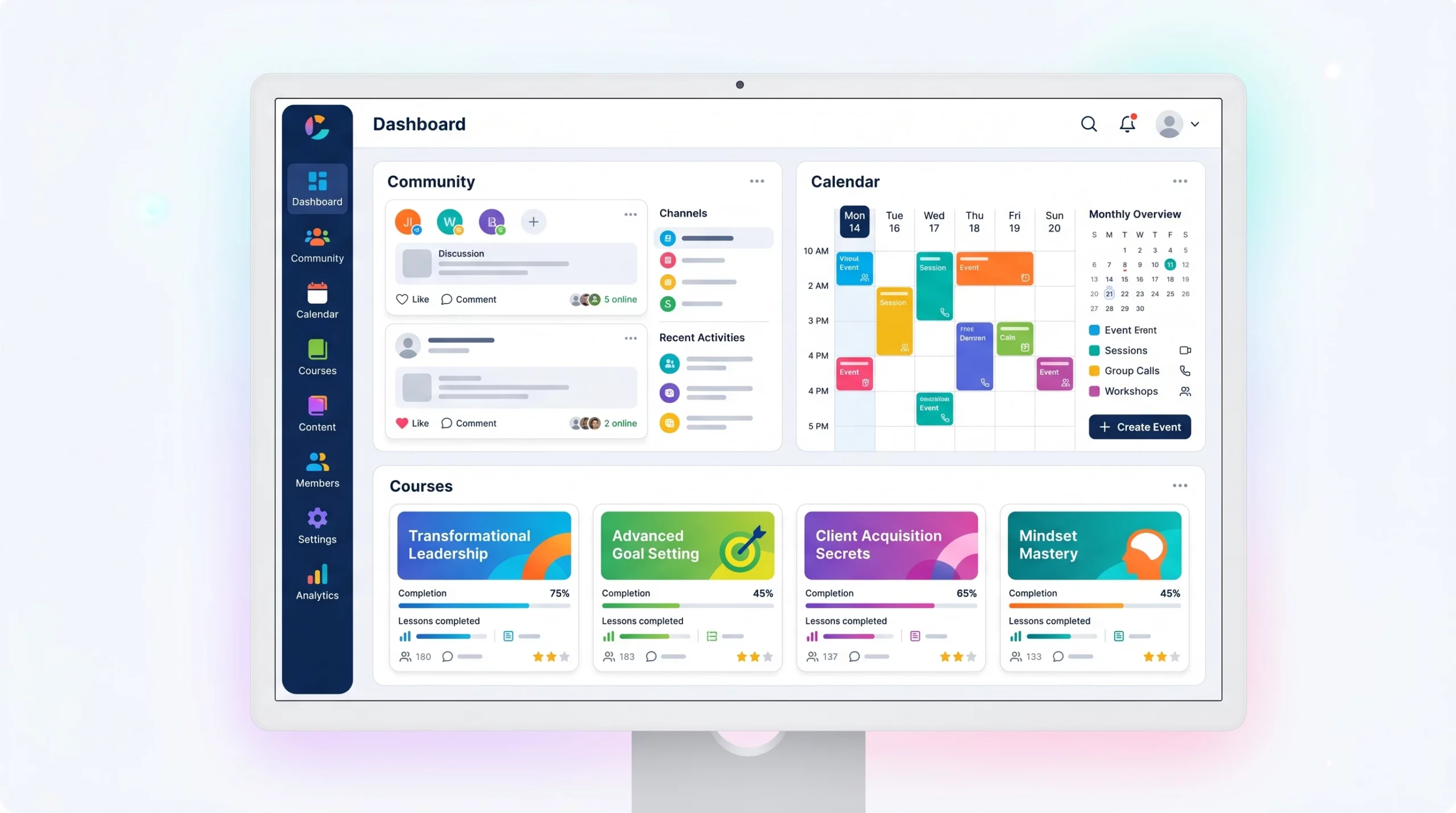
Skool is an all-in-one platform designed to help coaches manage their community, courses, and live sessions in a single environment. Instead of using multiple tools like Zoom, email platforms, and Facebook Groups, Skool centralizes everything, aiming to simplify operations, improve client engagement, and streamline the delivery of coaching programs.
If you’re searching for an honest Skool for coaches review, you’re probably tired of juggling multiple tools just to run your coaching business.
Running a coaching business shouldn’t feel like managing a tech circus. If you’re like me, your usual toolkit is probably bursting at the seams, Zoom for video calls, Mailchimp for emails, Kajabi or Teachable for courses, then Facebook Groups sprinkled in for community.
It works (sorta), but it’s a headache: logins everywhere, distractions, engagement dips, lost conversations, and a ton of time wrangling tools instead of focusing on clients. Skool brings a simple pitch: wrap all these pieces into one place so coaches can serve, scale, and actually enjoy the process.
TL;DR: Skool for Coaches
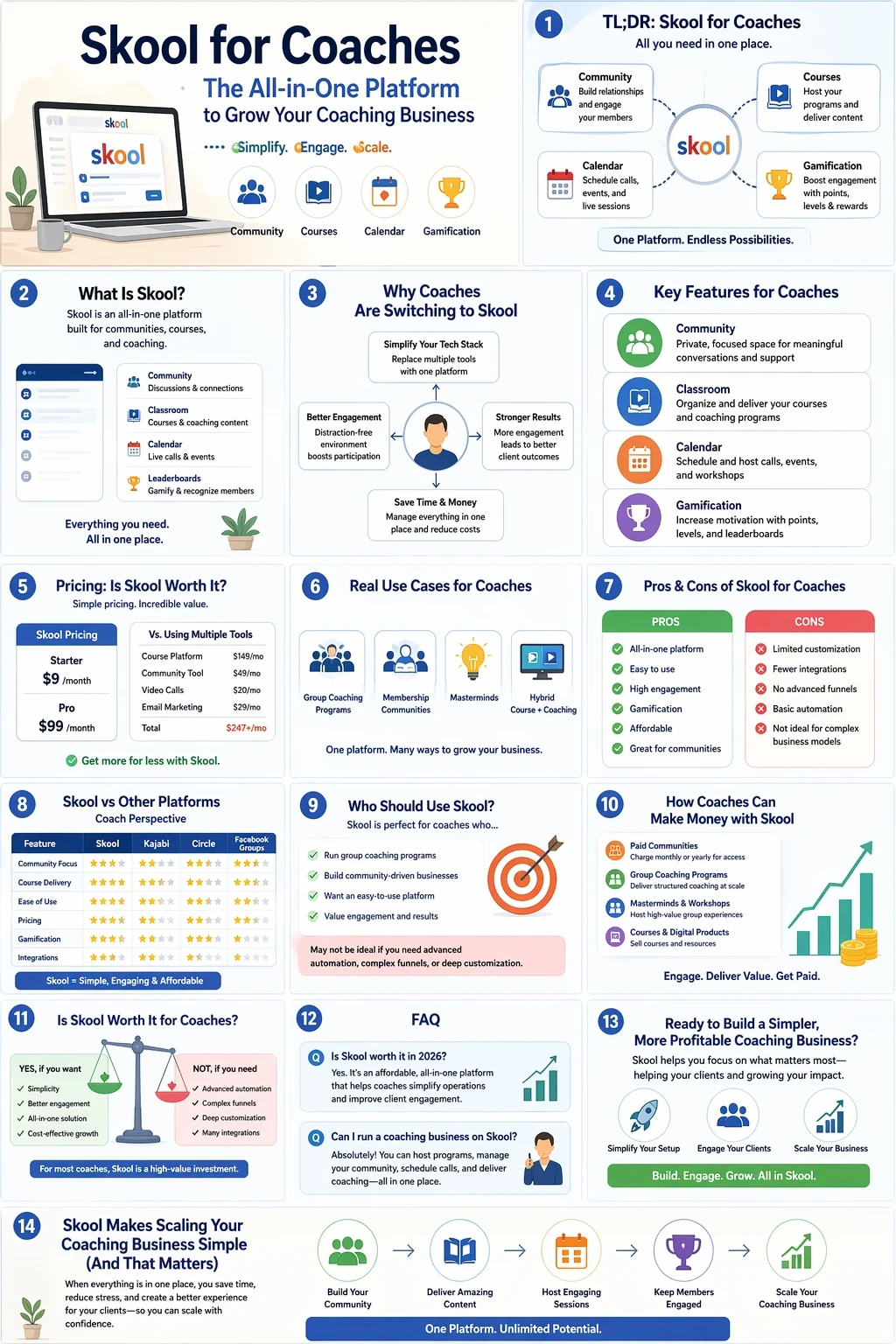
Skool is an all-in-one platform that combines community, course hosting, and scheduling into a single system for coaches. It reduces the need for multiple tools, improves client engagement, and simplifies program delivery. For coaches focused on group programs and memberships, it offers a streamlined and cost-effective solution.
Skool takes your group community, course hosting, coaching call calendar, and client engagement, putting them all on one sleek, easy to use platform. Coaches who switch to Skool report less friction, better results, lively community vibes, and a setup that’s dead simple. If your main goal is stronger client results and less hassle for everyone, Skool is absolutely worth checking out.
What Is Skool? (A Quick Look)
Skool is an all-in-one platform designed for coaches and consultants to manage their community, courses, and live events in one place. It combines a discussion-based community with structured learning and scheduling tools, making it easier to deliver coaching programs without relying on multiple platforms.
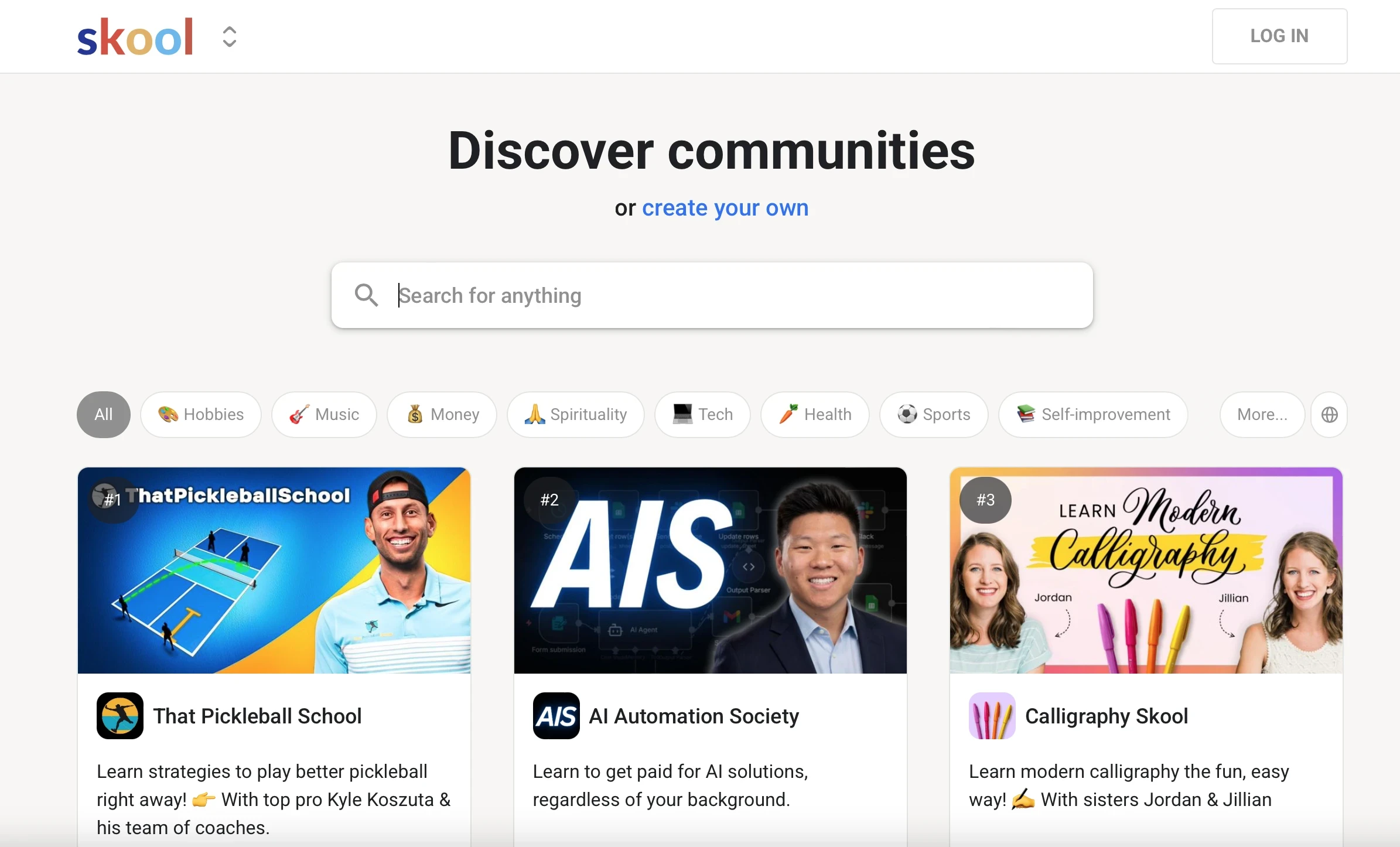
Skool is an all-in-one platform designed to help coaches, consultants, and group program creators run every aspect of their business in one place. The heart of Skool is the community hub, think of it as a forum meets social group, but it also bundles in course delivery, live event scheduling, and built in gamification features.
No coding, no confusing setups, no piecing together three different apps. Skool was actually built by coaches, for coaches, with a heavy focus on community and transformation, not just dropping another course and calling it a day.
Why Coaches Are Switching to Skool
Coaches are switching to Skool because it simplifies their tech stack and improves client engagement. By combining community, courses, and scheduling in one platform, Skool reduces complexity, minimizes distractions, and creates a more focused environment that helps clients stay active and achieve better results.
All-in-One Simplicity
I used to have separate tabs and subscriptions for every part of my business: Thinkific, Facebook Groups, reminders everywhere, and tangled up link trees just to keep it straight.
With Skool, everything lives together, your group, your course, your calendar, your content, and your coaching sessions. That translates to fewer tools to manage and way less “technical admin” eating into your time.
Better Client Engagement
Shifting from Facebook Groups to Skool was truly a breath of fresh air. Clients aren’t bombarded with ads, endless friend requests, and random distractions. They show up on Skool to learn, interact, and connect with you and each other.
The focused environment works as a natural accountability system, which is really handy for group programs. Plus, a vibrant group culture springs up quickly.
Improved Client Results
From my experience, as well as in Skool’s user groups, the winning formula is structured modules plus lively peer interaction. Add in the simple points and leaderboard system, and suddenly members are chiming in, participating, and finishing programs.
More wins for your clients means more testimonials and word-of-mouth growth for your business.
In my case, weekly participation improved noticeably after switching platforms. While engagement in Facebook groups often dropped below 30%, moving to a focused environment like Skool pushed participation significantly higher, especially during structured programs.
Before switching to Skool, my setup involved multiple tools for courses, community, and calls. Engagement was inconsistent, and clients often missed updates or struggled to stay active.
After moving everything into one platform, participation became more consistent. Members interacted more frequently, showed up to sessions more reliably, and overall communication became easier to manage.
Key Features for Coaches
Skool offers four core features: a community hub for interaction, a classroom for course delivery, a calendar for scheduling events, and gamification tools to boost engagement. These features work together to streamline coaching operations and improve client participation without requiring multiple tools.
Community: Your Client Interaction Hub
At the core, Skool’s community space is where clients share wins, ask questions, brainstorm, or even support each other. You get to control the vibe, there’s no algorithm dictating what your members see. All conversations are organized and easy to find. The sense of “we’re in this together” is real, and that drives retention and better results.
Classroom: Smooth Program Delivery
Coaching modules are easy to create, organize, and drip out as needed. You don’t have to explain five different login steps just to access your training, your clients can move from lessons to the community in one click, with zero tech headaches. Upload video, audio, PDFs, assignments, and even quizzes right inside Skool.
Calendar: Streamlined Scheduling
For group coaching calls, live Q&As, and workshops, you can schedule and run them all right inside Skool. Members get reminders, can RSVP, and everything is centralized, no more “Where’s the Zoom link?” each week. Every event is visible in a unified calendar your community can check anytime.
Gamification: Participation Booster
Clients earn points for showing up, commenting, or completing lessons, sparking friendly competition with leaderboards. This kind of gamification might seem basic, but honestly, it works. I’ve watched attendance and engagement numbers jump up just by making things a little more fun.
A less obvious advantage of Skool is how it reduces decision fatigue for both coaches and clients. With fewer tools and a clear structure, users spend less time figuring out where to go and more time taking action.
Pricing: Is Skool Worth It for Coaches?
Skool offers simple pricing with plans starting at $9/month and $99/month for advanced features. Compared to using multiple tools like course platforms and community apps, Skool can reduce overall costs. For many coaches, gaining one client per month is enough to cover the subscription.
Skool Pricing (2026)
Skool offers two main plans:
Hobby Plan: $9/month (or $7.50/month billed annually)
Pro Plan: $99/month (or $82/month billed annually)
Compared to tools like Kajabi ($179+/month), Zoom, and email platforms, Skool can replace multiple subscriptions with a single cost.
Skool almost always comes out ahead, especially once your group grows past the beginner phase.
In truth, landing even one coaching client per month covers the whole thing. It’s an easy win and turns from a cost into a true value add.
I think of value as time saved plus less stress, not just the price tag.
Real Use Cases for Coaches
Coaches use Skool to run group programs, masterminds, and membership communities. It supports structured course delivery, live coaching sessions, and ongoing interaction in one place, making it particularly effective for businesses that rely on engagement and accountability to drive client results.
A typical workflow on Skool might look like this:
1. A new member joins your community
2. They start with a structured course in the Classroom
3. They participate in discussions inside the Community
4. They attend weekly live sessions via the Calendar
5. They earn points and stay engaged through gamification
This creates a simple but effective system for delivering results.
- Weekly Group Coaching Program: Host your training modules in the Classroom, run weekly live calls via Calendar, and keep the group motivated inside Community, no outside apps or fragmented attention.
- High Ticket Mastermind: Run a private mastermind with exclusive recordings and VIP-level group calls. Skool’s simplicity actually feels more premium, not less, for clients who expect smooth access and support.
- Membership Based Coaching: Members pay a monthly fee to join, get access to you, your content library, and a thriving peer group. Skool makes billing and onboarding super straightforward for this style.
For example, a coach running a 6-week program can deliver all lessons, host weekly calls, and manage discussions without ever leaving the platform. This consistency often leads to higher completion rates compared to fragmented setups.
Pros & Cons of Skool for Coaches
Skool’s main advantages are simplicity, strong community engagement, and an all-in-one structure. Its limitations include fewer customization options, limited automation, and fewer integrations compared to more complex platforms. It is best suited for coaches who prioritize ease of use over advanced features.
- Pros:
- Super simple setup, no coding or tech overwhelm
- High engagement compared to most Facebook style groups
- Everything is in one place, easy to manage
- Group coaching programs really thrive here
- Cons:
- Limited customization (branding options are basic)
- No advanced funnel builder (you’ll still need external tools)
- Email marketing features are minimal
- Not ideal for large teams or agencies
If you want endless options for branding, landing pages, or tons of integrations, you might feel limited. But if you prefer clean and powerful tools, you’ll actually appreciate the streamlined approach.
Want to see how Skool works in practice? Check out the full platform here and explore how you could simplify your coaching setup.
Skool vs Other Platforms: Coach Perspective
Compared to Kajabi, Skool is simpler and more community-focused but less advanced in automation. Compared to Facebook Groups, it offers a distraction-free environment and better control. Against Circle, Skool stands out for built-in gamification and integrated course delivery.
Kajabi: Feature loaded and flexible, but setup is more complex and costs more. It’s great if you need a ton of landing pages and automations, though often at the expense of community spirit and ease of use.
Facebook Groups: Nearly everyone’s used them, and “free” is tempting, but you’re always fighting a stream of distractions, limited control, and lack of ownership. Skool delivers more focus, no ads, and you own your group even if Facebook changes the rules.
Circle: Excellent for building communities and conversations. Skool’s standout strength is integrated gamification and effortless program delivery. If you need a course plus community combo without a long list of settings, Skool is the simple winner.
| Feature | Skool | Kajabi | Facebook Groups |
|---|---|---|---|
| Community | ✅ | ⚠️ | ⚠️ |
| Courses | ✅ | ✅ | ❌ |
| Gamification | ✅ | ❌ | ❌ |
| Simplicity | ✅ | ❌ | ✅ |
Who Should Use Skool? (Coaches Edition)
Skool is best for coaches running group programs, memberships, or community-driven offers. It works well for beginners and intermediate users who want simplicity. It may not suit businesses that require advanced marketing funnels, automation, or complex team structures.
- Best fit for:
- Group coaching programs built around discussion and accountability
- Communitybased coaching (challenges, peer support)
- Beginner or intermediate coaches wanting to avoid headaches with tech
- Probably not for:
- Course sellers who need advanced marketing automation
- Large agencies with complex CRM or team needs
How Coaches Can Make Money with Skool
Coaches can monetize Skool through group coaching programs, paid communities, masterminds, and hybrid course models. The platform supports recurring revenue by combining content delivery with ongoing engagement, making it easier to retain members and increase lifetime customer value.
- Group coaching programs with recurring subscriptions
- Exclusive paid communities for experts or masterminds
- Hybrid courses built around community interaction
- All-in-one membership sites, clients pay for access, replays, and live calls
What stands out is how Skool removes friction, from offering to onboarding to client wins. You spend less time micromanaging technology and more time helping clients or growing your programs.
Is Skool Worth It for Coaches?
Coaches can monetize Skool through group coaching programs, paid communities, masterminds, and hybrid course models. The platform supports recurring revenue by combining content delivery with ongoing engagement, making it easier to retain members and increase lifetime customer value.
For coaches who value simplicity, genuine connection, and a smooth process, Skool is totally worth the monthly price. If you want deep technical features or advanced automations, another tool might suit you better. But for most coaching businesses, especially groups and memberships, Skool gets the job done, and more.
What Most Skool Reviews Don’t Tell You
Skool’s main advantage is not just its features but how they influence user behavior. By combining community, content, and interaction in one place, it reduces friction and distractions, leading to higher engagement and consistency. However, this simplicity can limit flexibility for users who need advanced automation or customization.
One thing many reviews overlook is that Skool’s strength isn’t just its features, it’s how those features influence behavior.
Because everything happens in one place, clients are more likely to engage consistently. There’s less friction, fewer distractions, and fewer excuses to drop off. That alone can have a bigger impact than advanced features found in more complex platforms.
However, this simplicity comes at a cost. If your business relies heavily on automation, detailed funnels, or custom integrations, you may feel limited compared to more advanced tools.
When Skool Is Not the Right Choice
Skool is not the best option for businesses that rely on advanced marketing funnels, complex automation, or deep customization. It may also fall short for large teams or agencies needing detailed user roles and integrations. In these cases, more feature-rich platforms may provide better scalability and flexibility.
Skool is not ideal for every coaching business.
If your strategy depends on complex sales funnels, advanced email automation, or highly customized landing pages, you’ll likely need additional tools.
It may also not be the best fit for large teams or agencies that require detailed user roles, CRM integrations, or multi-layered workflows.
FAQ
Skool is well-suited for coaching businesses because it integrates program delivery, community interaction, and scheduling in one platform. Coaches can run full programs, manage clients, and maintain engagement without relying on multiple tools, though external solutions may still be needed for advanced marketing functions.
Is Skool worth in 2026?
Yes, Skool is worth it in 2026 for coaches who want a simple, all-in-one platform. It combines community, courses, and scheduling in one place, helping improve engagement and save time. For most coaching businesses, just one client can cover the cost, making it a high-value investment.
Is Skool good for coaching?
Absolutely. It’s designed with group coaching and engaging your clients in mind, so you can deliver results and keep everything organized.
Can I host my entire coaching program on Skool?
Yes, you can build your curriculum, run live sessions, manage your community, and drip out fresh content, all from one hub.
Can I run a coaching business in Skool?
Yes, Skool allows you to run a full coaching business. You can host your programs, manage your community, and schedule live calls all in one platform. It works especially well for group coaching, memberships, and community-based offers.
Is Skool better than Kajabi for coaches?
If you want a blend of community and structured learning without a lot of tech fuss, yes. For deeper automations, Kajabi works, but it brings more complications.
How do coaches make money on Skool?
Popular ways include subscription coaching, paid communities, masterminds, and hybrid courseplusgroup programs. Payments process through Stripe for easy client setup.
Does Skool replace Zoom or email tools?
You can schedule sessions and link to Zoom easily, but Zoom itself isn’t embedded in Skool. Email automations are limited, most coaches still use outside email tools for bigger campaigns.
Ready to Build a Simpler, More Profitable Coaching Business?
Skool helps coaches simplify their business by combining community, course delivery, and scheduling into one platform. This reduces time spent managing tools and allows more focus on clients and growth. For coaches seeking efficiency and better engagement, it offers a practical way to streamline operations and improve overall results.
I’m a big fan of ditching messy setups so I can actually serve my clients, not just fix tech. Skool offers exactly what busy coaches need: one login, one monthly cost, and a spot people actually enjoy using. Give Skool a try, you just might find setup is smoother than you expect.
If you’re serious about simplifying your coaching business and improving client results, Skool is one of the easiest platforms to get started with.
Click here to explore Skool and see how it fits your business.
If you have questions or want help setting up your first coaching program, drop a comment below.
Your move. Are you ready to make your coaching business simpler and more fun? Drop any questions below, or let me know what Skool feature excites you the most!
Quick tip: The less time you spend on tech headaches, the more energy you’ll bring to your coaching, and that’s what makes growth and impact possible.
Skool Makes Scaling Your Coaching Business Simple (And That Matters)
Skool simplifies scaling by centralizing all key coaching functions in one system. With fewer tools to manage and a stronger focus on community engagement, coaches can reduce operational complexity, improve client experience, and grow their programs more efficiently without being slowed down by technical challenges.
Coaching is about connection and results, not fighting with endless plugins and scattered logins. That’s why a focused all-in-one platform like Skool stands out. Since moving to Skool with my programs, I handle fewer support requests, see higher group engagement, and enjoy a calmer experience for my clients and myself.
The real value of Skool isn’t just replacing tools, it’s removing friction from your coaching process. When everything is easier to access and manage, both you and your clients are more likely to stay consistent, and consistency is what drives results.
If you want strong results and less chaos, Skool is worth your attention. Why keep juggling random tools when your whole coaching business could run from a single dashboard? Try Skool and see for yourself how simple things can be. Take the tech clutter off your plate, put the focus back on your clients, and watch your business grow.